Pages

Showing posts with label Music Advocacy. Show all posts

Thursday, February 6, 2014

Music Activities with a Valentines Theme

Happy Valentines Day (week), everyone! Here's a little freebie printable poster you might enjoy:


This is a PNG file, which you can simply click on and print.


After presenting a full-day workshop and attending (and absolutely enjoying) UMEA, I am a bit slow posting some Valentines ideas. But if you are as busy as I am, you might be looking for some last-minute ideas. 

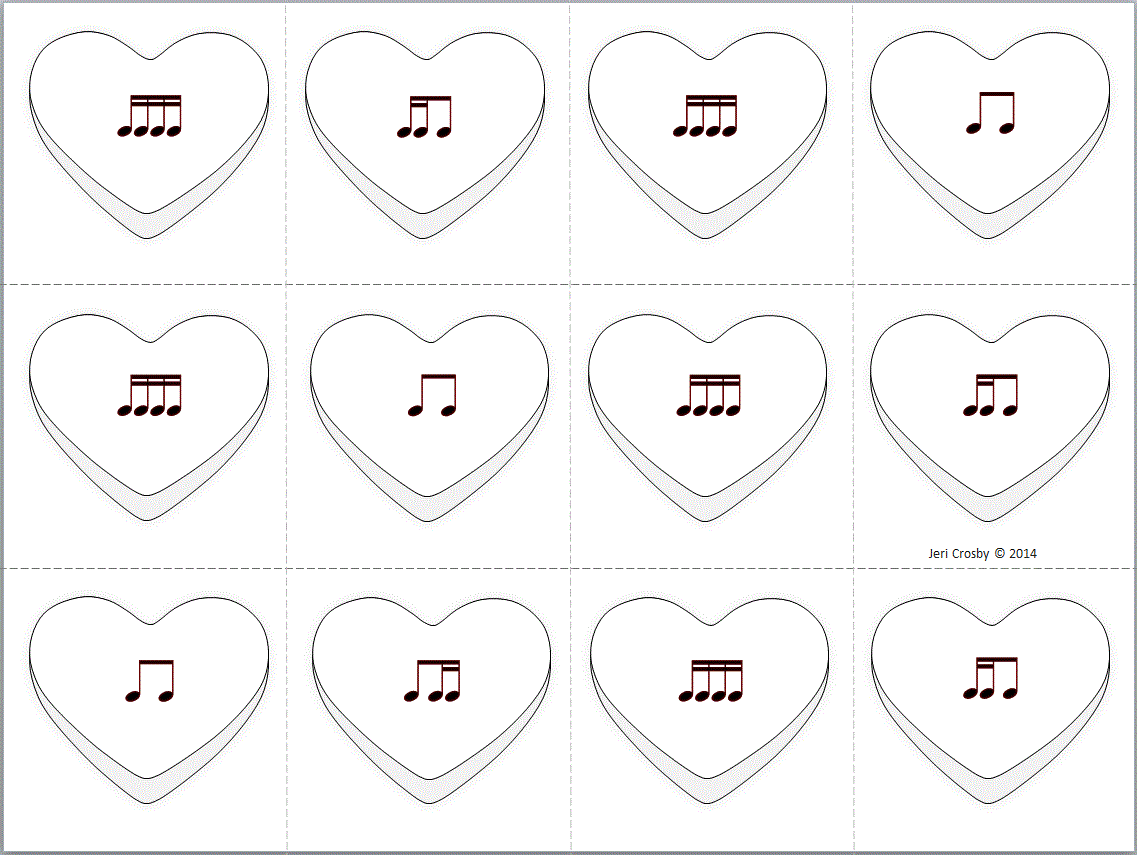
I have recently completed a few sets of Valentines activities: a note-spelling set with super cute Valentine graphics and two sets which use text-based rhythms from conversation heart candies. See samples of my layered ostinatos, composition cards, and measure mats below. I also composed a little poem to help students laugh at and feel comfortable working with the mushy text on candy hearts, which I will share below as a freebie.




Here's my poem / body percussion canon with instructions below:
(This is part of my "Love Notes with Candy Quotes" sets.) You can click on it to enlarge and project, print and/or save.


(1) Model by chanting the poem with an animated voice to a steady beat. (2) Have students pat the beat with 'spider legs' on thighs as you repeat it and match accented syllables to the beat.  (3) Add the actions/body percussion and practice. (Notes: actions are directly under the syllables they occur on. 'Open' is a silent gesture, as if opening a card. 'Brush' as if trying to get clean.) (4) Perform body percussion without audible text (but thinking the words and maintaining a steady beat).  (5) Divide the class into two groups and perform, beginning one stanza apart (as a round). If students are ready, perform this as a three- or four-part canon. Have fun! : ) 

Sunday, June 30, 2013

Music is 'Electrical Soil'

Here are a few favorite music advocacy quotes and my latest poster. Enjoy : )
(JPEG is printable.)


“When faced with a problem to solve, students in music and the arts produce more possible solutions, and their solutions are more creative, according to a nationwide study.”           
                             - N. M. Weinberger, Arts Education Enhances ‘Real Life’ Personal Skills,  
   MuSICA Research Notes, Spring 2000.

“…The ability to be creative is native to the arts and is one of the primary processes learned through arts education...  arts promote work habits that cultivate curiosity, imagination, creativity, and evaluation skills. Students who possess these skills are better able to tolerate ambiguity, explore new realms of possibility, express their own thoughts and feelings and understand the perspectives of others… Students’ capacity to create and express themselves through the arts is one of the central qualities that make
them human, as well as a basis for success in the 21st century.
                            -  21st Century Skills Map – The Arts, 2010,
                                   Partnership for 21st Century Skills, www.p21.org

Sunday, May 12, 2013

Music Enhances Problem Solving and Creativity


It's been a while since I've added a poster or posted some music and arts advocacy quotes, but end-of-year assessments and reflections have me thinking about the benefits of music education as it relates to creative thinking and problem solving. So here's a new poster and some favorite quotes I've collected:

“Too often students are given answers to remember, rather than problems to solve.”       
      Roger Lewin

“When faced with a problem to solve, students in music and the arts produce more possible solutions, and their solutions are more creative, according to a nationwide study.”        
         N. M. Weinberger, Arts Education Enhances ‘Real Life’ Personal Skills, 
            MuSICA Research Notes, Spring 2000.

“Education is not the filling of a pail, but the lighting of a fire.”     
         – William Butler Yeats (1865-1939)          (I've adopted this one as my mantra.)

“The principle goal of education is to create men who are capable of doing new things, not simply of repeating what other generations have done - men who are creative, inventive and discoverers.”          – Jean Piaget (1896-1980)

“The arts teach children that problems can have more than one solution and that questions can have more than one answer.”
            Elliot Eisner in The Arts and the Creation of Mind –  
            What the Arts Teach and How it Shows
                        (Absolutlely love this. So true!)

“…the ability to be creative – a key 21st Century Skill – is native to the arts and is one of the primary processes learned through arts education...  arts promote work habits that cultivate curiosity, imagination, creativity, and evaluation skills. Students who possess these skills are better able to tolerate ambiguity, explore new realms of possibility, express their own thoughts and feelings and understand the perspectives of others… Students’ capacity to create and express themselves through the arts is one of the central qualities that make them human, as well as a basis for success in the 21st century.
       21st Century Skills Map – The Arts, 2010,
            Partnership for 21st Century Skills, www.p21.org

Thursday, March 28, 2013

Cultural Connections - Music & Social Studies


My latest poster and a few of my favorite quotes about music and culture:

“We know an age more vividly through its music than through its historians.”                                                                              - Rosanne Ambrose-Brown

“The history of a people is found in its songs.”    
- George Jellinek

The truest expression of a people is in its dance and music.”   
                                                                             - Agnes de Mile (1905-93)
 
"The arts celebrate multiple perspectives. One of their large lessons is that there are many ways to see and interpret the world.”    - Elliot Eisner in The Arts and the Creation of Mind
   
I've been working with several sixth grade social studies classes (at different schools) to explore how environment has affected the development of ethnic music and art (a core objective). I play about 40 seconds of various multicultural selections (from a list I've compiled in Spotify) and have students fill in a listening chart, commenting on timbre, repeating melody or rhythm patterns, tempo, dynamics, and style, and then guessing what country or culture the music is from.

Next, as I review and replay about ten seconds of each piece, I show pictures of the ethnic instruments (which I've gathered from the Internet) and discuss the environmental and cultural influences that affected their development. Finally, I reveal the country or culture. Students really enjoy the 'big reveal.' This is a true integration (if you take time for it), as we are able to explore both curricula (music and social studies) and use music vocab in context. 

I've compiled a multicultural listening list in Spotify, and you are welcome to access/follow it. Here's a link: Multicultural . (You can also search for and download these pieces using iTunes, Amazon, etc.) I'm listing some of my favorites selections below.

Information appears in this order: Culture, Track/Title, Artist, Name of Album

India: Indian Summer, The Tigers of Bengal, Indian Raga

China: Chinese Wuhan Erhu, (Chinese Traditional), Chinese Traditional ErhuMusic
Russia: Gari Gari(Brule Brule), Jan Boutouk, Gypsy & Folk Music – Russia
Japan: Yamaji Yamato Ensemble, The Art of the Traditional Japanese Flute & Koto
Africa: African Meditation Music, African Drums, African Tribal Music
Germany: Rosamunde, Die Oberkariner Volksmusikanten, German Polka Party
Egypt/Arabia: Ayoub, Mohamed Maksoud, Oriental Sax – Turkish & Arabic Music
Spain: Punta del Faro, Paco de Lucia, El Flamenco Es…
Tahiti: Bora Bora (Tahitian Drums), The Polynesians, Luau Songs of Hawaii
Ireland: Irish Jigs, Irish and Celtic Music, Irish & Celtic – The Lord of the Dance
Mexico: Ay Jalisco no Te Rajes, Mariachi Mexico, Plaza Garibaldi
America: Shufflin’Blues, Paul Lenart, Acoustic Blues

Do you have any favorite multicultural songs or activities? Please share in the comment box : )


Friday, March 22, 2013

My Super-dooper Musical Cooper


This precious little guy (my grandson Cooper) feels 'musical magic' in every bone of his body! It's amazing how naturally little ones respond to music. Treat yourself to a half-minute chuckle : )

Sunday, March 17, 2013

Beautiful Music Quote


                               Music adds so much to life!
I enjoy creating these posters, and I hope my blog visitors and TPT customers enjoy them too : )   These JPEG files, FREE for your home or classroom use, can be printed. (Just click on the image, and a higher resolution file will open for you.)  If you use these electronically, please give credit by linking to my blog.


Thursday, February 21, 2013

Every child is an artist... and every artist listens to his/her inner child.


Today I was privileged to teach an all-day workshop to an amazing group of music teachers, and the day was filled with the joyful synergy of learning, creating and making music. I made this new little poster tonight as I've reflected on how remaining an artist keeps us young and excited about life, and yes, even our work. Actually, my work feels like play quite often : )


Believe it or not, today also brought the blessing of another grandchild, my third new grandson in the past three weeks. I will travel to meet him tomorrow, and I can hardly wait!

Tuesday, February 5, 2013

Expressing Feelings through Music


I've had an INCREDIBLY JOYOUS week with the birth of TWO grandsons on the same day -- two different families but only four hours apart! I was also able to attend the annual UMEA conference in St. George. It was wonderful to see so many friends and colleagues and gather and share ideas. I enjoyed pouring my happy feelings into my violin tonight, and then created this little poster to celebrate being able to express my joy and gratitude through music. (Visitors can click on this image and print or save it.) en-JOY! 

Friday, January 25, 2013

Brain Research and Music Education

Although many of us observe and note anecdotal evidence of the benefits of music education, it is exciting and amazing that scientists can now SEE and document how music affects our brains. Here are a few favorite research quotes about music and neuroscience:
 
“Young children who take music lessons show different brain development and improved memory over the course of a year, compared to children who do not receive musical training.” Dr. Laurel Trainor, Professor of Psychology, Neuroscience,
and Behaviour at McMaster University, Canada, 2006

“The ability to recognize music is contained in the prefrontal cortex, a part of the brain that also plays a key role in learning and in the response and control of emotions.” - Patricia Wolfe in Building the Reading Brain, 2004

“The relationship between musical and linguistic stimulus processing has been examined on a neurophysiological level in various studies and using various techniques, which reveal that both words and musical tones caused similar activity in the left superior temporal sulcus, temporal medial gyrus, angular gyrus, and frontal lateral lobe. It has also been shown that the primary auditory regions and supplementary motor areas respond similarly to linguistic and musical stimuli.” - Binder, Frost, Hammeke, Rai & Cox, 1996

“Arts Integration techniques, which use multiple senses to repeat information, cause more information to be stored in long-term —as opposed to short-term— memory, and may actually change the structure of the neurons. “
- Reinvesting in Arts Education: Winning America's Future Through Creative Schools
2010, President's Committee on the Arts andHumanities
 
Meta-analyses indicate that there is `a strong and reliable association between the study of music and performance on standardized reading and verbal tests´… Research now offers a theoretical basis for, and growing evidence of, the significant effects of learning shared between music and other measures of academic achievement.”
                       – Dr. Larry Scripp, An Overview of Research on Music and Learning


I will be posting more music advocacy and research quotes soon : )
It is rewarding and
motivating to be a

music educator!


Thursday, January 3, 2013

Rhythm and Fractions


Rhythm Pie


Reflecting on a couple of quotes in  previous posts prompts me to reshare them and write a bit about Rhythm Pie. Quote:

“The best way to learn is through the powerful force of rhythm.“
        - Wolfgang Amadeus Mozart (1756-1791)

“Second and third grade students who were taught fractions through musical rhythms scored one hundred (100) percent higher on fractions tests than those who learned in the conventional manner.”
   - Rhythm Students Learn Fractions More Easily, Neurological Research

I have had great success both in my music classes and math classes (I've taught both) by integrating pie fractions (math) with rhythm. Basically, I divide a circle ('pie') into fractions of 1/2, 1/4, 1/8 and 1/16 and put a note/symbol so named on each corresponding piece. This helps students understand where the notes get their names and gives me an opportunity to clarify that a half note does not sound for 1/2 beat, but for half of a four-beat measure. This method also helps students visualize parts and wholes as they relate to math AND music. The extension of composing rhythms solidifies the concepts.

I have received several emails this past month from teachers who attended a workshop where I shared my RHYTHM PIE lesson ideas, and they've reported great success in teaching the concepts and engaging their students in meaningful and enjoyable lessons. Teachers can easily adopt / adapt this idea themselves... or save themselves prep time, trial and error by purchasing my nifty set of ready-to-go lesson plans and high quality printables (7 pages) here:

http://www.teacherspayteachers.com/Product/Rhythm-Pie-Music-and-Math-Integration

P.S. A great online resource and reinforcement for this type of activity can be found here: http://philtulga.com/pie.html   Phil and his son do an amazing job with music and technology. Have you checked his site out?

Tuesday, January 1, 2013

Music Affects Literacy and Learning

Early in my career, I didn't understand the importance of ADVOCACY for music education. I KNEW music was making a wonderful difference in the lives of many of my students and in my school community, but I lacked the research base and determination to be vocal. I didn't want to appear self-promoting, and I assumed/hoped my administrators and students' parents would appreciate my hard work and speak up for my programs. Some did (thank goodness), but for most, music education was not a top priority. So collecting research articles and quotes became a hobby of mine. I now feel a responsibility to be an enthusiastic advocate. This blog is one way I hope to do so.

In today's post, I want to focus on how
MUSIC affects LITERACY and LEARNING


Music develops visual and auditory skills needed to read, listen and organize abstract thoughts, concepts and memories. Singing also develops speech patterns and skills needed for articulation and projection.                        
                - Dr. Dee Hansen, Music, Literacy and the Brain, U of U Conference Keynote, 2009

“Second and third grade students who were taught fractions through musical rhythms scored one hundred (100) percent higher on fractions tests than those who learned in the conventional manner.”
        - Rhythm Students Learn Fractions More Easily, Neurological Research, March 15, 1999

 
Music and poetry offer tracks for fluency in speaking, reading, and writing. Music and poems facilitate flow and pacing for both articulate and expressive speech. More than perhaps any other experience, interaction with others through playful speaking, listening, singing, moving, and being immersed in sound encourages and motivates children to receive and express ideas through language – the scaffolding for literacy.                         
                                                           - Dr. Peggy Bennett, 2009,  I Can Sing! I Can Read!

 “Research now offers a theoretical basis for, and growing evidence of, the significant effects of learning shared between music and other measures of academic achievement. The ‘two-way interactionist’ position is that improvement in  learning in either of two disciplines—taught separately or together—suggests that one discipline catalyzes, reinforces, and deepens learning in the other.”                                 
         - Larry Scripp, Director of Research Center for Learning Through Music, New England        
           Conservatory of Music

 
In 2009, Montgomery County, Maryland compared three arts integration-focused schools (AIMS) to three control schools over a three-year period. They found that AIMS schools with the highest percentage of minority and low-income students reduced the reading gap by 14 percentage points and the math gap by 26 percentage points over a three-year period. In the control schools, the number of proficient students actually went down 4.5%.
        - Re-investing in Arts Education: Winning Americ's Future through Creative Schools,
               2010, President’s Committee on the Arts and the Humanities


Monday, December 31, 2012

Music as a Driving Force Behind Learning


Music as a Driving Force Behind Learning
 

Musical Magic? If the title of my blog appeals to you, then you probably agree that music plays an integral part in the human experience. As an educator, I see first hand the difference music makes for so many students and teachers. I am passionate about music as a magnificent art form in itself. I am also fascinated with the magical effects music has in other areas of life, learning and creating.


Here are some of my favorite quotes regarding MUSIC as a DRIVING FORCE BEHIND LEARNING:
 
“The arts enhance the process of learning. The systems they nourish, which include our integrated sensory, attentional, cognitive, emotional, and motor capacities, are, in fact, the driving forces behind all other learning.”                                                 
                                                                                       – Eric Jensen from Arts with the Brain in Mind

"Much of what young children do as play - singing, drawing, dancing - are natural forms of art. These activities engage all the senses and help wire the brain for successful learning."
                                                                       - David A. Sousa in How the Brain Learns
 
“…if we hope for our children that they will become full human beings, and that they will move toward actualizing the potentialities that they have, then, as nearly as I can make out, the only kind of education in existence today that has any faint inkling of such goals is art education. “                             
                                                                               – Abraham Maslow, Psychologist, 1957

 “From fine-tuning muscular systems to integrating emotion and logic, the arts have important biological value. For their unique contributions to brain development, the arts and music take center stage in schools.”           
                                                 - Robert Sylvester, Professor of Elementary Ed., Eugene, Oregon

 “I would teach the children music, physics and philosophy, but the most important is music, for in the patterns of the arts are the key to all learning... Music is a more potent instrument than any other for education, because rhythm and harmony find their way into the inward places of the soul.”                                    – Plato

 
“The best way to learn is through the powerful force of rhythm.“
                                                                - Wolfgang Amadeus Mozart (1756-1791)


"
The value of arts education is often phrased in enrichment terms--helping kids find their voice, rounding out their education and tapping into their undiscovered talents. This is true, but as President’s Committee saw in schools all over the country, it is also an effective tool in school-wide reform and fixing some of our biggest educational challenges. It is not a flower, but a wrench."
 
     -   Re-Investing in Arts Education: Winning America’s Future Through Creative Schools 2010,
        President’s Committee on the Arts and the Humanities


If you have a favorite quote related to this post, please feel free to share/post it. I'd love to hear from you. More to come...

Three, two, one... blast-off! I'm excited to finally get this blog up and 'humming!'