Pages

Saturday, March 29, 2014

Spring and Easter Music Ideas and Freebies

I've added a fun yet meaningful activity for young students as a FREEBIE in my TPT Store. It can be used in centers or team activities to reinforce and assess so-mi-la, ta, ti-ti, rest and engage students in composing, clapping and singing. Here's a linked preview:


I've created some beautiful new materials for spring. These are favorites of my students, and I think you and your students will also find them useful and joyful. 


In my "Spring" Listening, Moving and Mapping set, I have included a two-page teaching guide, form-mapping cards for both younger and older students (Level I: ta, ti-ti, rest, ta-ah; and Level 2: ti-ti, ti-tiki, syncopa), printable and projectable sonnet text pages and score page, and links to music and additional resources.


My Spring Fling set is loaded with 70 text-to-rhythm cards, 48 possible ostinato strips / measure mats, and four detailed, engaging lesson plans with suggestions for extensions and variations.


These are some of my spring products posted last year which have received excellent feedback:


And last but not least, here's an oldie but goodie FREEBIE:  : )  


Happy Easter and happy spring! Thanks for stopping by!

Monday, March 24, 2014

More Home-made Stringed Instruments - How to Make a String-ophone

I'm a music 'junkie' in more ways than one! (1) I am  definitely hooked on music. I can't imagine life without it. (2) I hear music in everything - movement, language, environments, machinery, and junk. And if you follow my blog, you know I get a kick out of making instruments from throw-away and found items.

In my last post about how to make a bottle guitar, I promised more to come, so here are a few of my chordophone gems. These aren't just noise-makers; they are instruments capable of a fairly decent tone and a pitch range between four and eight notes. I have made these with groups of 20-30 students at a time (having done the cutting and drilling ahead of time). Here's a demo video of the twist-top instrument (pictures and instructions below).

Materials
A plastic bottle with a twist-top lid (rigid enough to support string tension)
String - heavy fishing line, thin wire, or a piece of a broken guitar string
Two plastic pony beads or buttons

Tools
An electric drill  (Please have an adult do the drilling and cutting.)
An X-acto knife, pocket knife or small paring knife
Felt-tip marker
Scissors

How To
(1)  Drill a small hole in the bottom center of your bottle.

(2)  Mark the area you want to cut out for a sound hole (approximately 3 cm wide by 8 cm long, or 1.2 in by 3 in). Puncture the bottle with your knife in the center of the area you have marked, and then carefully cut to and around the inside edge of your line. Note: Avoid cutting the opening too big because it will weaken the bottle. On some bottles, you can use scissors to cut the plastic once the hole is started.

(3)  Tie one end of your string to a bead (or button) using a square knot. 


(4)  Twist the lid to the open position, remove it from the bottle and keep it close by.

(5) Push the free end of the string into the hole you drilled in the bottom of the bottle. Guide the string through the bottle and out the top.  Then push the string through the twist-top lid and screw the lid back onto the bottle.

(6)  Pull the string as tight as possible with one hand while turning the twist-top to the closed position with your other. 


(7)  Draw the top piece of string through a bead (or button) a couple of times, pulling tightly. Then tie a square knot under the bead and trim excess string.

(8)  Decorate with stickers or marker if desired. Enjoy! As in the video above, pluck the string through the sound hole and twist the lid to change pitch.

Here are some variations using various bottles (including a 2 liter pop bottle, a pancake syrup bottle, and a one liter pop bottle). In place of a twist top, tie the string to a clothespin or short wooden dowel and tip the stick to create tension on the string.


Here's a link to a great website by a fellow music 'junkie,' Nick Penny. Check out his video instructions for making a 'Poptar' with a 2 liter bottle:  http://www.youtube.com/watch?v=he215SLuOLI

Wednesday, February 26, 2014

St. Patrick's Day Note-Spelling & Freebie

Just a quick update... I've uploaded several St. Patrick's Day-themed note-spelling sets in my store
(1)  33 treble spaces-only words/slides,
(2)  28 treble lines-only slides,
(3)  a combination set with a whopping 83 words, and
(4)  a set of printable or projectable note-spelling staff pages, icons and instructions for several activities with a magnetic whiteboard or as a floor game. (Pictures are hyperlinked to the products.)

Also, in appreciation to my followers, I'm including a printable or projectable staff page below (from the Treble Treasures set). Just click on the bottom image in this post to enlarge or print it. You can project this and use it on a whiteboard or print it and have students 'spell' various words using candies, magic coins (pennies) or math counters as notes and have fun! : )


Freebie Printable or Projectable - Click on this PNG file to enlarge or print.
Happy St. Patrick's Day. Thanks for stopping by!

How to Make a Bottle Guitar

If you follow my blog, you know by now that I enjoy making instruments out of found items just for the fun (and challenge) of it.  I also love to help students create instruments that actually make music.

Making a good chordophone (stringed instrument), not just a look-alike, can be a challenging project. Through trial and error, I've found a couple of easy ways to create playable, decent sounding string instruments that can produce a variety of pitches.

In making any instrument, there are three main components to consider: (1) a source of vibration, (2) a resonator or hollow cavity to amplify the sound, and (3) a device or technique for regulating/varying pitch. When creating a stringed instrument, suspending the string while supporting its tension presents a unique challenge. Having a strong fingerboard and solid hollow body are keys to success. In this post, I want to share my bottle guitar ideas with some basic guidelines for creating these. 

Materials:

     Fingerboard - part of a yardstick or a paint stick will do 
          (Mine had paint samples already on it for 'frets.')
     Plastic bottle
           (Shampoo and dish soap bottles are pictured.)
     Small pieces of wood or plastic for nut and bridge 
          (I used a small Lego for one of my bridges.)
     String - fishing line, wire, or rubber bands 
          (Pieces of old guitar or violin strings work great.) 
     Stickers or markers to decorate (optional)

Tools:

     Electric drill
     Exact-o knife or small pocket knife
     Small hack saw if your plastic is extra hard
     Needle-nose pliers if using metal string
     Glue (to hold nut or bridge in place)
     Please have an adult do any cutting and drilling.

Instructions:

(1) Decide how you will attach the string to the fingerboard. You can attach it at each end which will require holes at each end (as in the green guitar) or wrap it completely around the fingerboard and connect the ends on the back side of the stick. Drill holes if needed.

(2) Design a nut (a small piece of wood or plastic that will hold the string above the fingerboard) and attach it to the top end of the fingerboard. 

(3) Design a bridge (piece of wood or plastic about 1 cm or 1/3 inch high) to insert under the string and suspend it above the fingerboard. 

(4) Setting the bridge aside for later, tighten your string onto the fingerboard (as tight as possible).

(5) Create the body of your instrument by cutting a sound hole (and plucking space) in the front/face of your bottle. 

(6) Cut or drill notches in the bottom and neck of the bottle to snugly fit and support your fingerboard. (Please study pictures below.)

(7) Insert your fingerboard into the bottle neck and slightly through the slot in the bottom of your bottle.

(8) Insert the bridge under your string(s).

(9) Decorate and mark finger placement if desired.

(10) Pluck the string through the sound hole with your dominant hand, and press the string against the fingerboard with your other hand to change the pitch. Have fun!


More chordophones to come in my next post. Thanks for stopping by!


Thursday, February 6, 2014

Music Activities with a Valentines Theme

Happy Valentines Day (week), everyone! Here's a little freebie printable poster you might enjoy:


This is a PNG file, which you can simply click on and print.


After presenting a full-day workshop and attending (and absolutely enjoying) UMEA, I am a bit slow posting some Valentines ideas. But if you are as busy as I am, you might be looking for some last-minute ideas. 

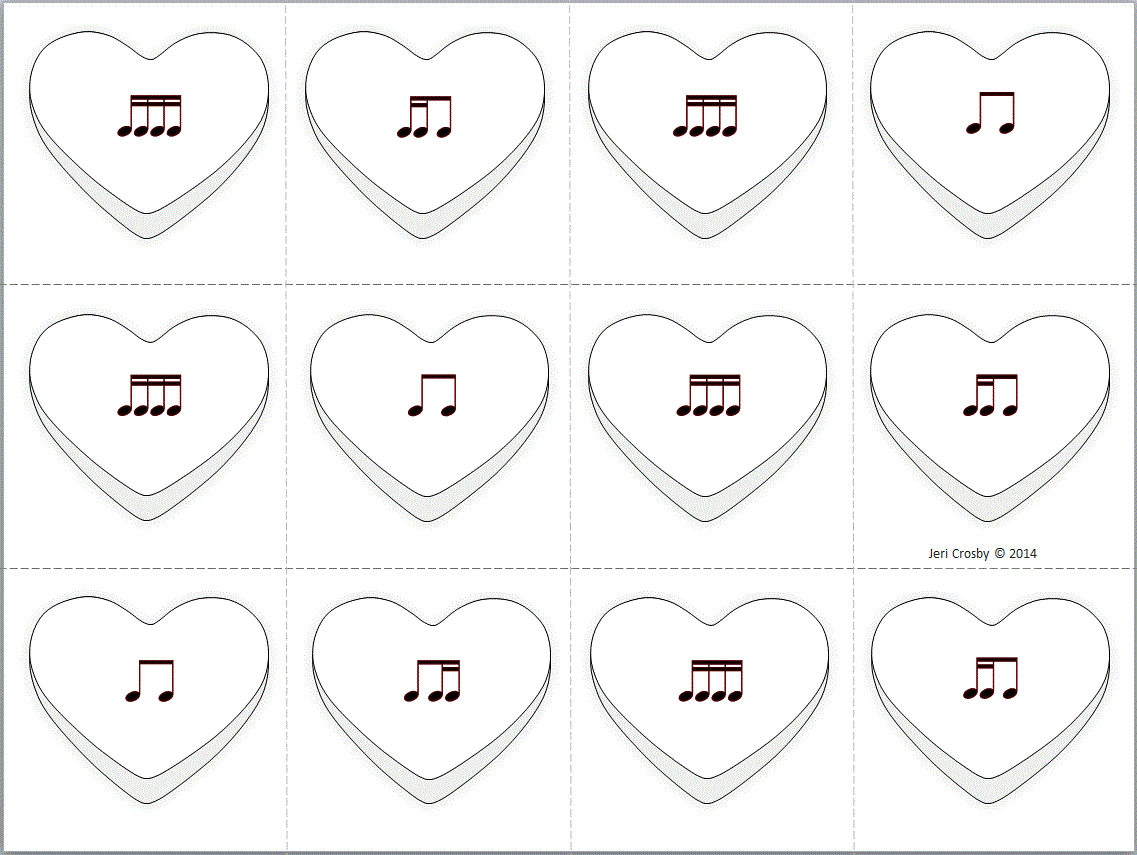
I have recently completed a few sets of Valentines activities: a note-spelling set with super cute Valentine graphics and two sets which use text-based rhythms from conversation heart candies. See samples of my layered ostinatos, composition cards, and measure mats below. I also composed a little poem to help students laugh at and feel comfortable working with the mushy text on candy hearts, which I will share below as a freebie.


Here's my poem / body percussion canon with instructions below:
(This is part of my "Love Notes with Candy Quotes" sets.) You can click on it to enlarge and project, print and/or save.


(1) Model by chanting the poem with an animated voice to a steady beat. (2) Have students pat the beat with 'spider legs' on thighs as you repeat it and match accented syllables to the beat.  (3) Add the actions/body percussion and practice. (Notes: actions are directly under the syllables they occur on. 'Open' is a silent gesture, as if opening a card. 'Brush' as if trying to get clean.) (4) Perform body percussion without audible text (but thinking the words and maintaining a steady beat).  (5) Divide the class into two groups and perform, beginning one stanza apart (as a round). If students are ready, perform this as a three- or four-part canon. Have fun! : ) 

Saturday, January 25, 2014

Winter Games for the Music Classroom - 'Music Olympics' Ideas

This month I've been working with an amazingly receptive and creative elementary school faculty, and it has been invigorating! (A shout-out to these wonderful teachers and their administrator!) The only downside is that I've had very little time to blog or work on personal projects. But with the Winter Olympics coming up, I do want to post a few favorite ideas and let my followers know about my Winter Games sets.

My students and I have had a lot of fun and success with a 'Music Olympics' theme, based on both summer and winter events. And the teachers I've shared this with have reported great success as well. Here's an outline of some of my favorite activities:
A few of my printables and medals made from chocolate coins.
I create an 'OPENING CEREMONY' by having students move to a piece composed for the Olympics. My favorite pieces for this segment are Leo Arnaud's "Bugler's Dream" and John Williams' "Call of the the Champions" and "Olympic Spirit." 

Whether I have the children march and wave small flags (which I use for patriotic programs), move freely with ribbons, or engage them in choreographing a piece, my main objectives are to have them experience and express the joy and majesty of these pieces and hear the music multiple times. Once they've experienced the music and developed positive feelings about it, we are ready to explore the elements embedded in the music: rhythm, melody, texture, timbre, dynamics, etc. I do this simply and actively, often by challenging them to order cards containing melody, rhythm, or form patterns. Some Olympic melodic themes are very simple (even pentatonic). What a thrill for the kiddos to discover this!  

Next, I introduce (or review) common competitive events by showing brief video clips from the Official Olympics Website or YouTube. One really fun (and easy) activity I've done involves turning off the sound and having students create a soundtrack for the video clip. (I have also used the soundtrack technique at a much deeper level with middle and high school instrumental students.) Here's a sample sound track with graphic notation:


On the same day (or the next if time runs short) I give students text-based rhythm cards (with winter games words), which they use to compose measures. I have students add actions to their words/rhythms and perform them/teach them to the class. Being passionate about teaching composition early, I then have students combine their patterns to create various A-B forms or rondos. 

In a subsequent lesson(s), I create 'Music Olympics' centers, through which small groups rotate. Students actually work quite hard in these, but the novel activities feel like play. Some of the activities I use include note-placement on a floor staff (curling), slalom (racing through a course of music symbols), meter races (placing barlines), vocal explorations (half pipe or aerials), and note-spelling down a 'luge' course, etc.

I create medals (for everyone) with ribbon and foil-covered chocolate coins... so cute! You can also purchase inexpensive (plastic) medals through Party Land or Oriental Trading. 


Slalom Center
Speed Skating Center

I hope these ideas inspire you to try something like this with your students. It can be a lot of work, but it's worth it... and hey, it doesn't have to be a lot of work because... this year, I finally compiled three 'Winter Games' packets! These contain my best 'Winter Games' ideas, detailed teaching guides, links to resources including an online playlist, and a lot of useful ready-to-go printables -- everything needed to 'host' a great event (one day or several lessons). If you're thinking of doing a 'Music Olympics' this year or 'Winter Games' any year, please check out my materials. I've really put a lot of work into these so you won't have to, and I think you and your students will have great success with them. Thanks for stopping by!


Winter Games Centers or Whole-Class Activities


Sunday, January 5, 2014

Music Literacy Activities for Chinese New Year

Happy New Year! I hope your holidays have been joyful and rejuvenating. Mine were wonderful and filled with family fun. And now it's back to work for me... At least I'm passionate about what I do! : )

I am excited about some music activities related to Chinese New Year and the Chinese Zodiac, which I'll be doing in January and February. I have recently completed a packet of music literacy activities for Chinese New Year and two related, educational games for classroom projection or computer center. 

 
Chinese New Year begins on January 31, this year (2014) and continues through February 14th. (It always begins on the second new moon/no moon after Winter Solstice.) This holiday inspires many cultural and musical connections. Here are a few integration ideas and a printable music activity freebie (grayscale option and more links below):

Chinese New Year is the longest and most important holiday in the Chinese calendar. In China, people take time off work (sometimes several weeks) to get ready for and celebrate the New Year. Chinese New Year is also called "Spring Festival' because people are preparing to say goodbye to winter and greet the 'new' year (spring).  These are some things people do to celebrate Chinese New Year:
     Have family reunion feasts

     Decorate with poems on red paper
     Give money in red envelopes
     Shoot off or watch fireworks (to scare away evil spirits)
     Wear red clothing 

          (Red represents fire which can keep bad luck away.)
     Clean their houses to sweep away any bad fortune and make room

          for good luck
     Participate in the Lantern Festival (On the 15th day, people hang

          lanterns in temples and carry them to an evening parade.)
     Participate in a Dragon Dance or parade (This is the highlight of

          the Lantern Festival on the 15th day. Long dragons made of paper,
          silk, and bamboo are held in the air by a line of dancing young men
          who wind through the streets of the town.)

Consider which of these activities could be adapted and added to enhance students' enjoyment and understanding, e.g. wear red clothing, clean the classroom, create poems or red paper, create and decorate paper lanterns, or create a long paper dragon and a dragon dance. 
Have children move/dance to recorded music such as "Dragon Dance" by Heritage Dragon, "Dragon Dance – Festival Celebration" by Hanshin Chinese Folk and Dance Ensemble, or Ballad of Four Seasons by Hanshin Chinese Folk Ensemble.

Here's a link to an excellent post about Chinese New Year music: http://makingmulticulturalmusic.wordpress.com/2014/01/06/learn-a-chinese-new-year-song/

When I found some darling Chinese Zodiac clip art on Etsy by ElsyDesign, I was inspired to get busy and update my oldie-but-goodie ideas as well as create some new digital and printable materials. 

Here's a link to a simple but very useful FREEBIE printable, which you can use to create rhythm patterns based on the syllables of the Chinese Zodiac animals. This will help your students practice simple rhythms (ta, ti-ti, rest combinations) while making cultural and calendar connections. Print, cut, and put in envelopes to create center activities such as (1) syllabic rhythm sorting and (2) measure-making, or (3) give one card to each student and have students form groups of four to create and perform measures of rhythm. 

Chinese Zodiac Rhythm Cards - Freebie on TPT
Pentatonic Memory Game using the Chinese Zodiac

These syllabic-rhythm cards are a natural and engaging extension for my Chinese New Year Measure-Maker:
Chinese New Year Measure Maker
The rhythm cards are a sample page from my 32-page set of Music Literacy Activities to Celebrate Chinese New Year. In this set, I include a variety of eye-catching printables with instructions for whole-class and center games/ activities, additional resources and suggested curriculum connections.
Music Literacy Acitivites to Celebrate Chinese New Year
 I have also created a great game for projection or computer center with the Chinese Zodiac/New Year theme, which includes sound clips of the melody patterns:  

Happy New Year, and happy Chinese New Year!

Wednesday, December 4, 2013

Christmas Bells for Primary Grades


Wow, December is upon us just like that! Celebrating Thanksgiving so late in November seems to have shortened the Christmas season a bit, so some of you may be looking to simplify holiday lessons or performances. Here's an easy, fun (yet worthwhile) activity I'll be doing with K-2 classes at several schools this month.
 
Practice chanting the poem to a steady beat first. Then have students play assigned bells on the beat, and sing all syllables that belong to one beat on the pitch the designated bell produces. I have several of these I hope to add to my TPT store soon. For now, here's a freebie 4 U. Enjoy it with your kiddos! : )
   
 http://www.teacherspayteachers.com/Product/Rhymes-and-Chimes-for-Christmas-Time-Five-Poetry-to-Song-Activities-for-Bells-1012129
 
 
I'm back : )  I finished the set of
Rhymes and Chimes for Christmas Time, and I'm having so much FUN with this! I designed this material for myself, K-3 classroom teachers, music teachers, home-schoolers, and families. There are some great language fluency skills that come with this 'spoon full of sugar,' and the language concepts and activities flow into musical ones so easily. Also, this is the easiest way to put together a musical performance with bells and young children. Here are some sample pages:


http://www.teacherspayteachers.com/Product/Rhymes-and-Chimes-for-Christmas-Time-Five-Poetry-to-Song-Activities-for-Bells-1012129http://www.teacherspayteachers.com/Product/Rhymes-and-Chimes-for-Christmas-Time-Five-Poetry-to-Song-Activities-for-Bells-1012129
 
I created five pieces with five options for each:  poem text, poem text with accented syllables (the ones bells will be played on), colored text, colored text with bell icons, and actual notation for teacher reference or older students. (Teachers and students don't need to be able to read the music notation to be successful with this.) I've also included a sheet of printable labels to color-code plain chimes or bells.

You can click on a sample page to go to my store and purchase this set of five piece set (20 pages of printables or projectables).  Thanks for stopping by!


Tuesday, November 19, 2013

XOXO - You'll Love this Holiday Play-Along

Here come the holidays! And here's one my favorite holiday play-along activities for classroom, music room or easy-to-prepare performance. This video has been a favorite with many student groups (and their teachers). In appreciation of my followers and TPT customers, I want to share it here. This activity will help students experience and explore timbre, melody, form, and rhythm ostinatos in a joyful, novel way.

Instructions
You will need one pair of rhythm sticks and one wrist bell band for each student. I make wrist bells by stringing three jingle bells onto a piece of braided (flat) elastic. These are a great investment and will serve you well for many years.

Have students put the wrist bell band on their dominant wrist -- the one they use to hold their top rhythm stick. Have them play along with the video, reading the iconic notation for the ostinatos. The "X" means to tap their sticks on a beat, and the "O" means to shake their bells (while still holding sticks). 


For younger students, use the macro beat, at a tempo of 82 BPM. For older students or adults, use the micro beat at a tempo of 164.  
 
Explore and map the form of this delightful composition with your students. Then let them compose new ostinatos using "X' and "O."  Enjoy!
 
Form: Introduction, A, A (softer w/flute variation), B (mallets), bridge (intro.), A (clarinet), A (louder), bridge (bass clarinet), C (brass), D (bass clarinet, tuba), C (circus-like), bridge, A, A(louder), coda