Pages

Tuesday, April 30, 2013

Boom Pipes Recipe

Boom Pipes
Instructions for Boom Pipes 
                                                                            by Jeri Crosby
Boom pipes are a novel yet musical addition to my Orff instruments (substituting for bass bars) as well as to my Boomwhackers and home-made instrumentarium. Students (of all ages) LOVE these!
Use four-inch, double-walled drain pipe (white plastic with black inner lining, which usually comes in ten-foot lengths). Buy a four-inch end cap for each pipe and some adhesive. (Three ten-foot lengths will make a full set. You can make a basic ‘bass bar’ set from two lengths.)

These measurements are approximate. (It is best to cut a tiny bit long because a pipe that’s too short will be sharp and difficult if not impossible to correct.) After initial cuts, check pitch with a tuner or match to a piano. Sand or carefully shave with a paring or pocket knife to fine tune.


C       50 ½ “          128.3 cm       (Cut from piece #1.)
D       45 “              114.3 cm      (Cut from piece #2.)
E       40 ½“           102.9 cm       (Cut from piece #1.)
F       37 ¾ “            95.9 cm       (Cut from piece #2.)
F#        35 ½ “            90.2 cm        (Cut from piece #3.)
G       33 ½ “            85.1 cm        (Cut from piece #2.)
A       29 ½“             74.9 cm         (Cut from piece #3.)
Bb        28 “                71.1 cm          (Cut from piece #3.)
B       26 ¼“              66.7 cm         (Cut from piece #1.)
C       24 ¾“              62.9 cm         (Cut from piece #3.)

‘Boom’ on carpeting or other soft surface. If you’ll be using these on cement or tile, glue a piece of indoor/outdoor carpet to the bottom (cap) of each tube.
The range of these instruments is from two octaves below middle C to one octave below middle C. (This is the same as bass Boomwwhackers with Octavator caps applied, but the volume and timbre are bolder.)

A printable version of instructions and picture is available here:
http://www.teacherspayteachers.com/Product/Boom-Pipes-Recipe-Instructions-for-Making-Home-made-Bass-Set 

For color-coded music and activities, please check out my TeachersPayTeachers store: http://www.teacherspayteachers.com/Store/Musical-Magic
I'll be posting more home-made instrument ideas soon : )

Monday, April 29, 2013

Multicultural Scales Activity

Like many adults and children, I am intrigued with multicultural music, and I find the theory that underlies ethnic scales, rhythms, ragas, etc. fascinating. Tonality seems to pull on the soul like an invisible tide. Children are capable of exploring much more than major, minor, and pentatonic scales if we set them up to succeed. One of my favorite activites to engage upper elementary through college students in exploring ethnic tonalities involves, believe it or not, Boomwhackers (or bells). Here's a basic outline:


You may click on this FREE poster to save and print it.

Lay a chromatic set of Boomwhackers (or bells) out along the front of your classroom in order from left to right (as in my chart). Invite 13 students, one for each instrument, to come and take their places. Have them sit on the floor or chairs.

Call out note names belonging to a particular scale and have students who have these notes stand. Then direct students in playing the scale ascending and descending as the rest of the class listens carefully. Challenge students to guess the country or culture that uses the scale. Explore half-steps, whole-steps, and wider intervals by looking at the visual spacing created when student players stand.

Here are a few scale examples to try:
C     D     E  F     G      A     B  C     (Major to establish familiar tonality)
C C#           F      G  Ab           C      (Japan, diminished pentatonic)
C     D  Eb      F# G  Ab       B  C      (Russia and Hungary, 'gypsy' minor)
C          Eb  F  F# G          Bb   C      (U.S.A., blues scale, Afro-American)

Try it out with your kiddos and enjoy some FUN music theory! If you'd like more in-depth materials, check out my Music and Scales Around the World package on TPT:


Saturday, April 20, 2013

Color-coded Labels - Freebie 4 U

If you have older, plain, or home-made pitched instruments, you can include them in your Boomwhacker or bell activities by applying these colored labels. Simply print, cut out, and apply them with a piece of tape slightly larger than the label. If you have access to sticky-backed printing paper, this will save you the hassle of cutting and applying tape. However, tape gives protection to the label, so it may last longer. When using tape for label application, I have found that Scotch Magic Transparent tape (specifically this brand) is less likely to get gummy.

Saturday, April 13, 2013

Pomp and Whack-'em-stance Freebie

Make graduation fun and extra memorable this year! Here's another FREEBIE: the melody for Pomp and Circumstance arranged for Boomwhackers or bells. (This is a JPEG file. Click it to download or print.)

If you're interested in doing a larger-scale performance, I've created an arrangement with full harmony and materials & suggestions for adding recorder, flute, violin, xylophone, guitar and/or ukulele. It's avaiable from my TPT store. (You can click the picture below to check it out.)


Thursday, April 11, 2013

Boomwhacker Pentatonic Chart - Freebie


Here's another FREE Boomwhacker Chart for my visitors. This is a downloadable/printable JPEG file, or you can download a free (higher resolution) PDF from: http://www.teacherspayteachers.com/Product/Color-coded-C-Pentatonic-Scale-Poster-or-Resource-Page-for-Bells-or-Boomwhackers 

If you use Boomwhackers with your students or family, I invite you to check out some of my Color-Chord-inated Song Collections. Teachers tell me these materials save them a lot of time (and knowing how much time I put into them, I must agree!). They are great for end-of-school-year activities, summer programs, and easy-to-put-together performances. I am delighted to know that students and teachers are having great success with these materials!


http://www.teacherspayteachers.com/Product/The-HOEDOWN-COLLECTION-of-Color-Chord-inated-Songs-for-Bells-or-Boomwhackers


http://www.teacherspayteachers.com/Product/The-PATRIOTIC-COLLECTION-of-Color-Chord-inated-Songs-for-Bells-or-Boomwhackers


http://www.teacherspayteachers.com/Product/50-Partner-Tunes-to-Sing-Bing-Boom

Friday, April 5, 2013

Boom-whacka-wow!

When I first encountered a set of Boomwhackers years ago, I would have never guessed the phenomenal success they would have. I've always enjoyed making homemade instruments, so these 'boom tubes' fit into my novelty category, and that seemed good enough. I didn't think Boomwhackers were especially musical, the intonation was often poor, and the name conjured up visions of students smacking everything in sight! So yes, I resisted them for a while...

But then I began working with dozens of schools with very limited budgets. Orff instruments weren't an option; handbells or ukuleles - not a chance. Yet, I still needed to train teachers and their students how to play melodies and create ostinatos and chord accompaniments in a hands-on, enjoyable way. Happily, I discovered the Octavator Caps, which (1) greatly enhance the BW tone, (2) drop the pitch an octave, and (3) enable tapping the capped end on a soft surface such as the heel of the hand or carpeted floor. And I found that kneading the tubes into a round, smooth shape (and avoiding squishing them in storage) helped improve intonation.

I started experimenting with techniques I've used with resonator bells and handbells. (I'd used a color-coded system of my own for 20 years, so I simply tweaked it to match BWs.) Another 'booming' surprise has been how well my Color-Chord-inated song collections have been received by many teachers. (See my TPT listings at http://www.teacherspayteachers.com/Store/Musical-Magic.)

Anyway, after seeing these cRaZy TuBeS work well in so many situations, I must admit I'm a fan! They have enabled thousands of students in my district to engage in, explore and create music, and I've discovered some useful integrations too. (I mentor elementary classroom teachers as well as music teachers.)


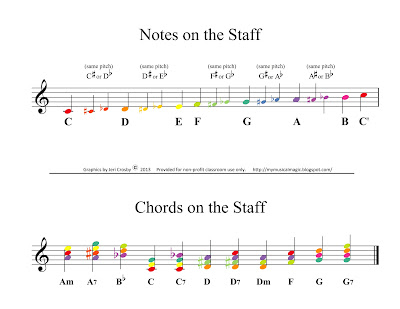
Here's a
 FREEBIE chart with the color-coded chromatic scale and common chords on the treble staff, which you can project or print. (Click on the image above to open and save/print a high-resolution file.) If desired, you can scale/enlarge when you print and then cut out note or chord cards. Simply click on it to download. You'll find another Boomwhacker FREEBIE in my Partner Song Freebie post (3/7/2013). In coming days, I will post additional ideas for using Boomwhackers to engage students in enjoyable learning experiences. Thanks for visiting!


Thursday, March 28, 2013

Cultural Connections - Music & Social Studies


My latest poster and a few of my favorite quotes about music and culture:

“We know an age more vividly through its music than through its historians.”                                                                              - Rosanne Ambrose-Brown

“The history of a people is found in its songs.”    
- George Jellinek

“The truest expression of a people is in its dance and music.”   
                                                                             - Agnes de Mile (1905-93)
 
"The arts celebrate multiple perspectives. One of their large lessons is that there are many ways to see and interpret the world.”    - Elliot Eisner in The Arts and the Creation of Mind
   
I've been working with several sixth grade social studies classes (at different schools) to explore how environment has affected the development of ethnic music and art (a core objective). I play about 40 seconds of various multicultural selections (from a list I've compiled in Spotify) and have students fill in a listening chart, commenting on timbre, repeating melody or rhythm patterns, tempo, dynamics, and style, and then guessing what country or culture the music is from.

Next, as I review and replay about ten seconds of each piece, I show pictures of the ethnic instruments (which I've gathered from the Internet) and discuss the environmental and cultural influences that affected their development. Finally, I reveal the country or culture. Students really enjoy the 'big reveal.' This is a true integration (if you take time for it), as we are able to explore both curricula (music and social studies) and use music vocab in context. 

I've compiled a multicultural listening list in Spotify, and you are welcome to access/follow it. Here's a link: Multicultural . (You can also search for and download these pieces using iTunes, Amazon, etc.) I'm listing some of my favorites selections below.

Information appears in this order: Culture, Track/Title, Artist, Name of Album

India: Indian Summer, The Tigers of Bengal, Indian Raga

China: Chinese Wuhan Erhu, (Chinese Traditional), Chinese Traditional ErhuMusic
Russia: Gari Gari(Brule Brule), Jan Boutouk, Gypsy & Folk Music – Russia
Japan: Yamaji Yamato Ensemble, The Art of the Traditional Japanese Flute & Koto
Africa: African Meditation Music, African Drums, African Tribal Music
Germany: Rosamunde, Die Oberkariner Volksmusikanten, German Polka Party
Egypt/Arabia: Ayoub, Mohamed Maksoud, Oriental Sax – Turkish & Arabic Music
Spain: Punta del Faro, Paco de Lucia, El Flamenco Es…
Tahiti: Bora Bora (Tahitian Drums), The Polynesians, Luau Songs of Hawaii
Ireland: Irish Jigs, Irish and Celtic Music, Irish & Celtic – The Lord of the Dance
Mexico: Ay Jalisco no Te Rajes, Mariachi Mexico, Plaza Garibaldi
America: Shufflin’Blues, Paul Lenart, Acoustic Blues

Do you have any favorite multicultural songs or activities? Please share in the comment box : )


Friday, March 22, 2013

My Super-dooper Musical Cooper


This precious little guy (my grandson Cooper) feels 'musical magic' in every bone of his body! It's amazing how naturally little ones respond to music. Treat yourself to a half-minute chuckle : )

Sunday, March 17, 2013

Beautiful Music Quote


                               Music adds so much to life!
I enjoy creating these posters, and I hope my blog visitors and TPT customers enjoy them too : )   These JPEG files, FREE for your home or classroom use, can be printed. (Just click on the image, and a higher resolution file will open for you.)  If you use these electronically, please give credit by linking to my blog.


Friday, March 15, 2013

Rain Songs are "so mi!"

Spring fever has hit, and I'm having so much fun lately with childrens' songs about rain! The rain theme itself inspires manipulatives and fun visuals, plus the simple melodies inspire meaningful rhythm and pitch explorations, improvisations and composition. A few of my favorites (simple as they are) include: Rain, Rain Go Away (so-mi-la); It's Raining, It's Pouring (so-mi-la); Rain, Come Wet Me (so-mi-re-do), Rain on the Green Grass (do-re-mi-so-la), and Rain is Falling All Around (diatonic).

The first four mentioned can actually be sung as partner songs because their tone sets fall within the pentatonic scale... and that inspires ostinatos! Here are a couple of  'rain' ostinatos, color-coded for Boomwhackers or bells. This is a JPEG file so you can click on it to save it, and then project, enlarge, and print it if desired.  

I have created some excellent lesson plan sets and teaching materials around the rain theme for spring. (So much experience, work and time has gone into these!) You can check out preview files of these sets by clicking on the cover pages below.


These raindrop note heads are a sample from my newest publication, Rain on the Green Grass Musi-Kit. You may also save and print this FREEBIE. Happy spring, everybody!